My Teaching
An important part of working at a university is the contact to undergraduate and graduate students. I strive to apply modern didactic methods to further develop my teaching in solid mechanics and multi-field modeling.
Mechanics of Beams and Shells
MW-MB-SIM-08/LB-12 | 6th/8th Semester
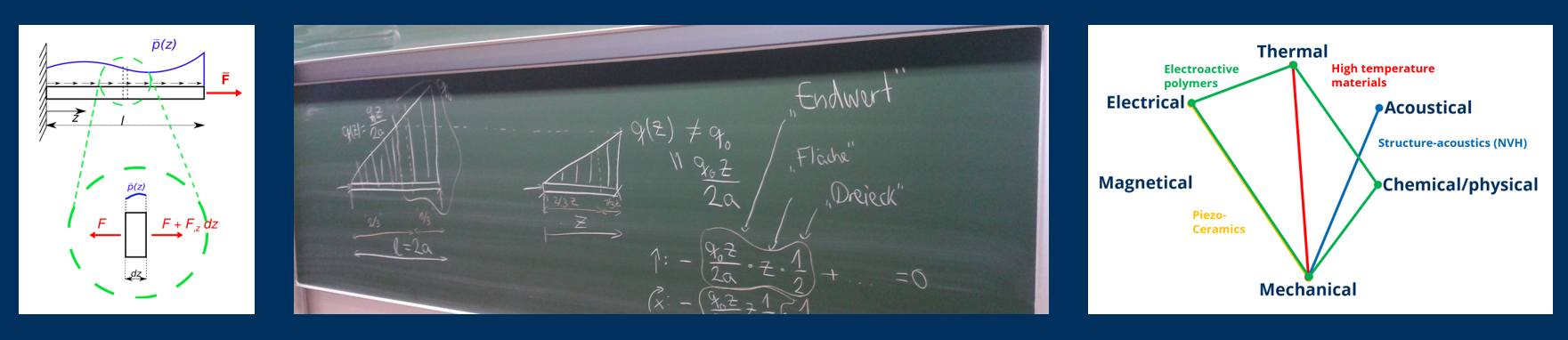
The lecture covers the transition from 3D bodies to 1D and 2D structures. Key topics include Bernoulli & Timoshenko beam theories, Airy disk theory......
In the summer semester, the lecture in Mechanics of Beams and Shells ("Stab- und Flächentragwerke") starts. The main contents of this lecture are:
- Basics of continuum mechanics for 3D bodies.
- 1D structural mechanics theories for rods and beams (Bernoulli & Timoshenko theory, warping torsion)
- 2D structural mechanics theories for disks (Airy theory) and plates (Kirchhoff & Reissner-Mindlin theory)
- Introduction to Classical Laminate Theory
- Introduction to shell theories
The lecture is aimed at 6th semester students in "Simulation Methods" and 8th semester students in "Lightweight Construction" (both specializations in Mechanical Engineering).
Continuum Mechanics & FSI
MW-MB-LRT-24/SIM-22 | 9th Semester
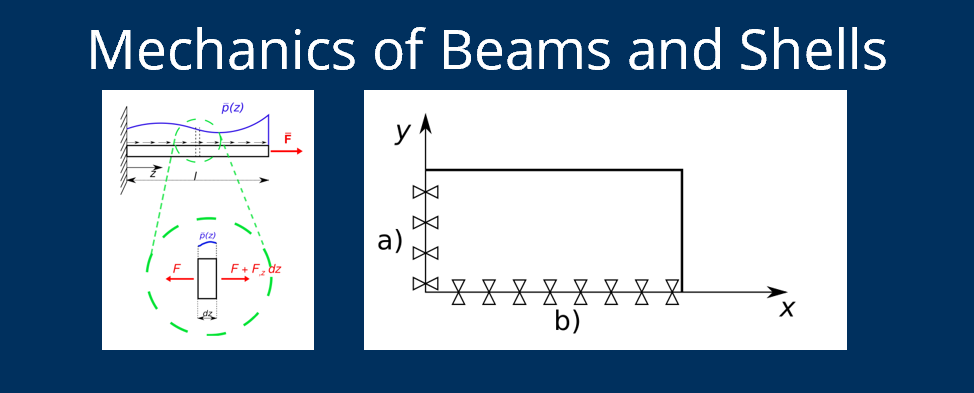
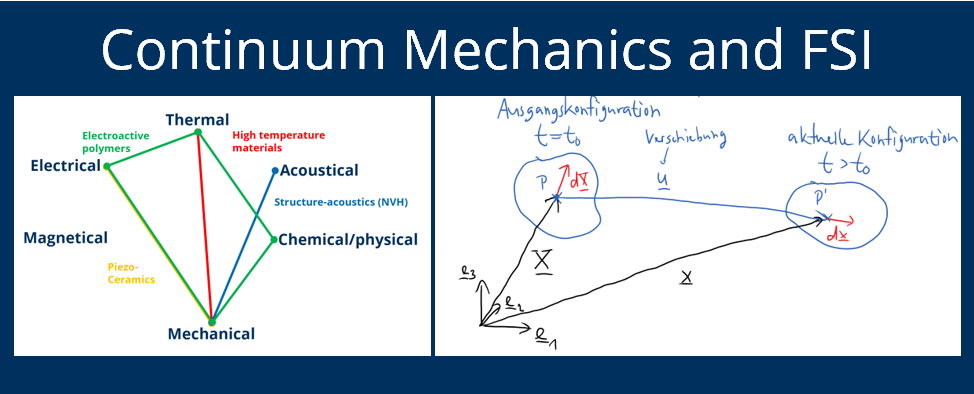
A joint lecture between solid and fluid mechanics institutes, officially called "Struktur, Strömung und Kopplung". In the first part, we explore solid mechanics and coupled field problems...
The second part is focused on the special coupled problem of Fluid-Structure-Interaction (FSI) and is taught by the Institute for Fluid Mechanics. The main contents of our first part are:
- Introduction to tensor notation
- Kinematics of large deformations and deformation speed
- Balance laws in multi-field problems
- Principles of constitutive models (assumptions and classification by Haupt)
- Application of the Finite Element Method for multi-field problems (thermo-mechanics, electro-mechanics, chemo-electrics)
The lecture is aimed at 9th semester students in "Aerospace Engineering" (specialization in Mechanical Engineering).
LLMs in Solid Mechanics
Special Course | 2024 - now
Discovering the role of Large Language Models in study and research. We experiment with how AI can assist in understanding...
In 2024 I also started the course "Einsatz von Sprachmodellen für das Studium der Festkörpermechanik (Application of Language Models for the study of solid mechanics)". The goals of this seminar are:
- To discover, together with the students, the role that Large Language Models can play in study and research.
- Experiment with how AI can assist in understanding and solving complex solid mechanics problems.
- Assess prompt engineering methods, code generation validation, and critical assessment of LLM capabilities and limitations in physical simulation.

SustAInING
An interdisciplinary course about the sustainable development and application of AI
Students and teachers alike are beginning to integrate genAI into their everyday work. Technical background about how these kinds of systems work, are highly beneficial for an effective and ethical use of these systems...
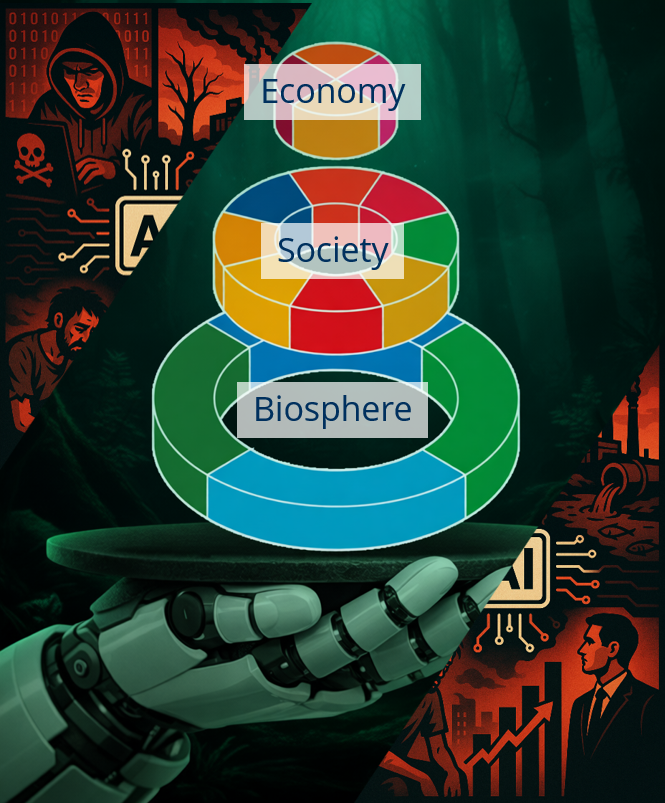
As teachers from different disciplines (me: from materials informatics; Dr.in Sandra Buchmüller from Gender Technology and Design research), we offer you a unique interdisciplinary course: Together we consider AI-based technologies along the three dimensions of sustainability: environmental, societal and economical. Based on practical examples (prompting chatbots, image generation, ...), students can learn to critically assess the models outputs and limitations, to use them reflectively in their studies (knowledge management, exam preparation, thesis writing) and to shape them responsibly in their future professional role.
The course includes various practical assignments, comparisons between manual and AI solutions, and practical tips about prompting.
Find out more in our OPAL course (in German).
AI Tools for LLM understanding
Open Source Software for supporting my courses
Interactive software tools help to to understand Generative AI and especially LLMs in the context of Engineering education and research...
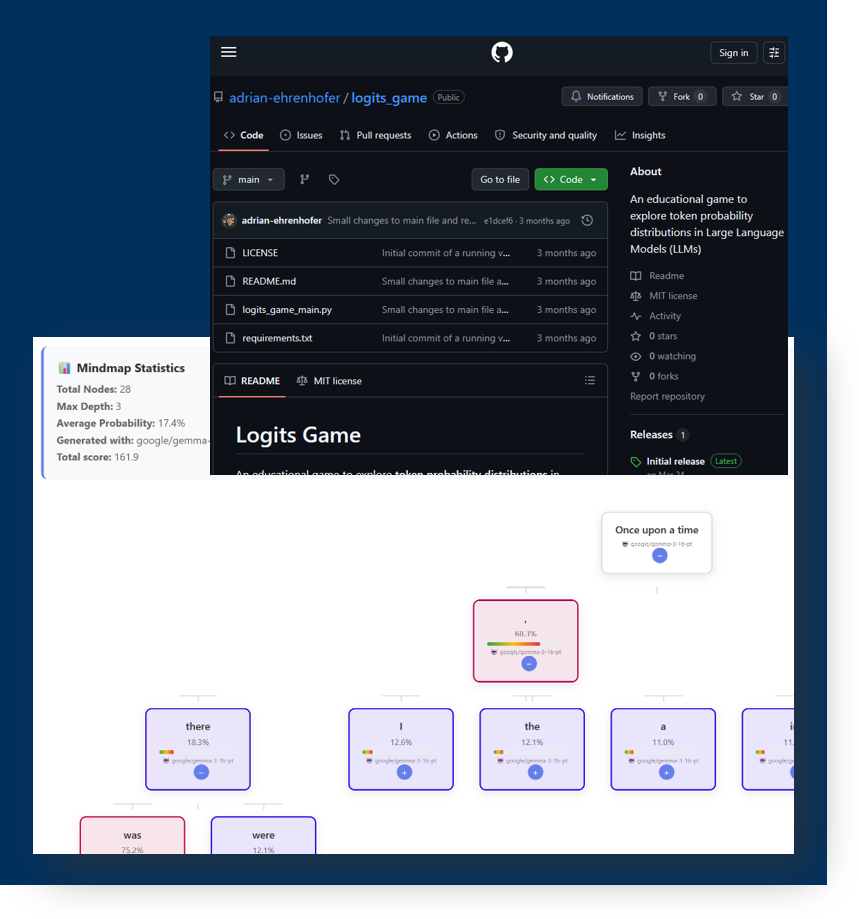
To help students and researchers in developping an intuition for how Large Language Models work, I provide interactive educational software. One example is the Logits Game, which visualizes how transformer models compute logits and the derived token probability distributions during next-token prediction.
By gamifying the exploration of temperature, top-k, top-p, and logit bias settings, users learn how these parameters influence generative randomness and decoding strategies in a practical, hands-on environment.
All tool code is available in my Github repository. A next version will follow soon, contributions are welcome!
Demonstration Model for Beam Bending
QUIX Project | Haptical Experience
A physical demonstration model for skew beam bending, allowing students to rotating profiles and obtain straight bending...
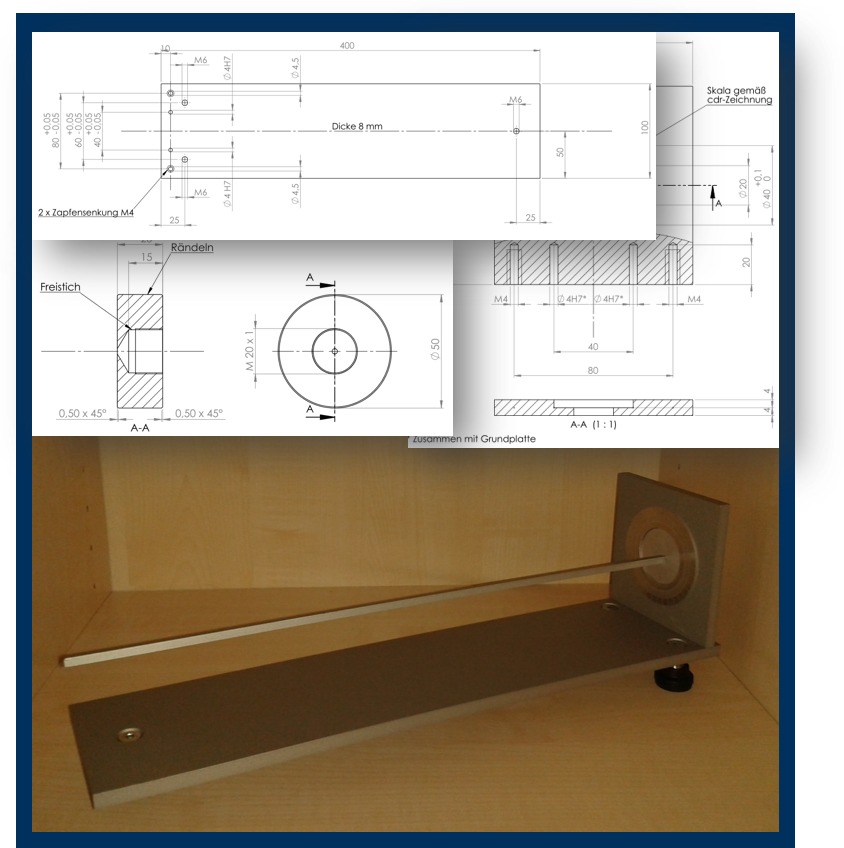
In course of the QUIX project by the Student's Council of the TU Dresden (StuRa), we designed and fabricated 5 models for basic Engineering Mechanics.
The construction is a demonstration model for skew beam bending. The beam is clamped on one side and designed such that a visible bending can be easily caused by hand. In the case of non-symmetrical profiles (e.g. L-profile), the skew bending because of the deviatory moment of inertia is easily recognizable.
At the same time, the support of the beam allows the profile to be freely rotated. When the students calculate the respective principle coordinate system, they can rotate the beam to the correct angle and obtain straight bending. The system is now used in the basic course Engineering Mechanics to demonstrate this effect.